Asian Long-horned Beetle (Anoplophora glabripennis)
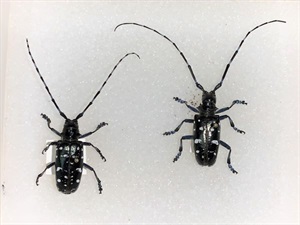
Asian long-horned beetle grubs prefer maple trees but can feed on 29 species of hardwoods. The grubs create feeding tunnels inside the tree. When they change into adults, they bore their way out of the tree, creating holes large enough to fit a pencil. Once the beetle infests a tree, there is no known cure. This insect was discovered in South Carolina in June of 2020.
These insects can be transported to new locations by people moving firewood or tree parts infested by Asocial long-horned beetles. Please do NOT transport firewood to or from campsites or campgrounds!
The North Carolina State University Extension, North Carolina Department of Agriculture’s Plant Industry Division, and North Carolina Forest Service have developed a “Poolside Pests” program. Learn more about the program and report sightings.
Emerald Ash Borer (Agrilus planipennis)
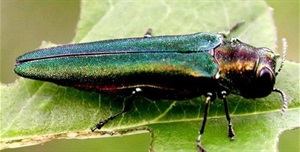
The emerald ash borer (EAB), a metallic green beetle that bores into ash trees, was first discovered in the United States near Detroit, Michigan in 2002. It has since spread to 30 states, including 25 counties in North Carolina. EAB infestations have killed hundreds of millions of ash trees, with a significant impact in Charlotte since its detection in 2017. All species of ash trees, including North Carolina’s native white ash, green ash, Carolina ash, and pumpkin ash, are susceptible to EAB damage.
The beetle’s larvae feed on tree tissues beneath the bark, leading to nutrient and water movement blockage and eventual tree death. Signs of infestation include a distinctive “D”-shaped exit hole in the bark, canopy thinning, and top-down dieback. Insecticides can be used for protection, but regular re-treatment is necessary.
Approximately 1,300 ash trees in Charlotte’s public right-of-way are managed by the city, and there are resources available to identify and learn more about ash trees and EAB.
Fall Canker Worm (Alsophila pometaria)
Charlotte has a history of severe cankerworm infestations. But in the last five years, cankerworm populations have plummeted. Local arborists believe an extended frost in 2017 and 2018 affected the newly hatched caterpillars. This disrupted the insect’s life cycle, resulting in fewer moths the next seasons.
City staff will be monitoring willow oaks across the city to be prepared when cankerworms reappear. Residents who experienced defoliating trees last spring should continue to band their trees. There are many species of caterpillars that feed on oak trees throughout the year. Be sure to properly identify the caterpillars prior to banding.
Become a citizen scientist and collect data on cankerworms. Learn how.
Orange-Striped Oakworm (Anisota senatoria)
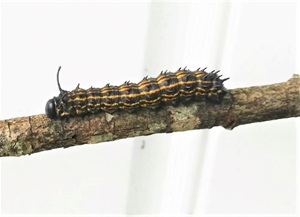
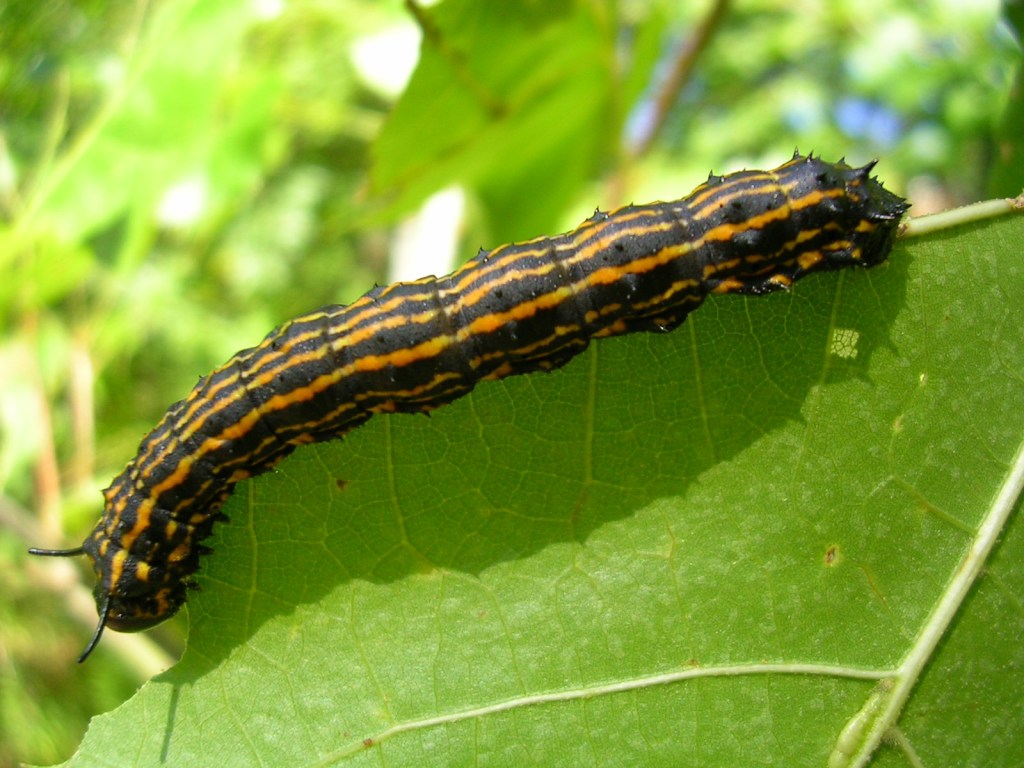
Between August and September in North Carolina, the orange-striped oakworm emerges, its favorite food is oak leaves, but it will also indulge in maple, birch, and hickory leaves. These caterpillars, about two inches long, can be spotted on sidewalks, under trees, or leaving frass pellets (feces) on decks and patios. By fall, their feeding is done, and they head down tree trunks to pupate, causing any harm to the tree before that point. Generally, healthy trees survive their presence, as the damage is confined to small areas. Charlotte residents can find relief in this, but for those still concerned, more information can be found here.
Spotted Lanternfly (Lycorma delicatula)
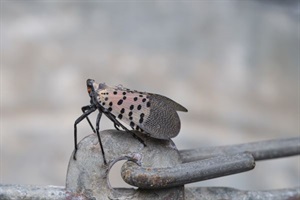
The spotted lanternfly feeds on maple, polar, tree of heaven, birch, apples and many other species. It is native to China and has been discovered in several states, including Virginia and West Virginia.
These insects can be transported to new locations by people moving firewood or unknowingly transport the eggs on vehicles and personal belongings. Please DO NOT transport firewood to or from campsites or campgrounds!
The North Carolina State University Extension, North Carolina Department of Agriculture’s Plant Industry Division, and North Carolina Forest Service have developed a “Poolside Pests” program. Learn more about the program and report sightings.


 Canopy Conversations
Leave a comment